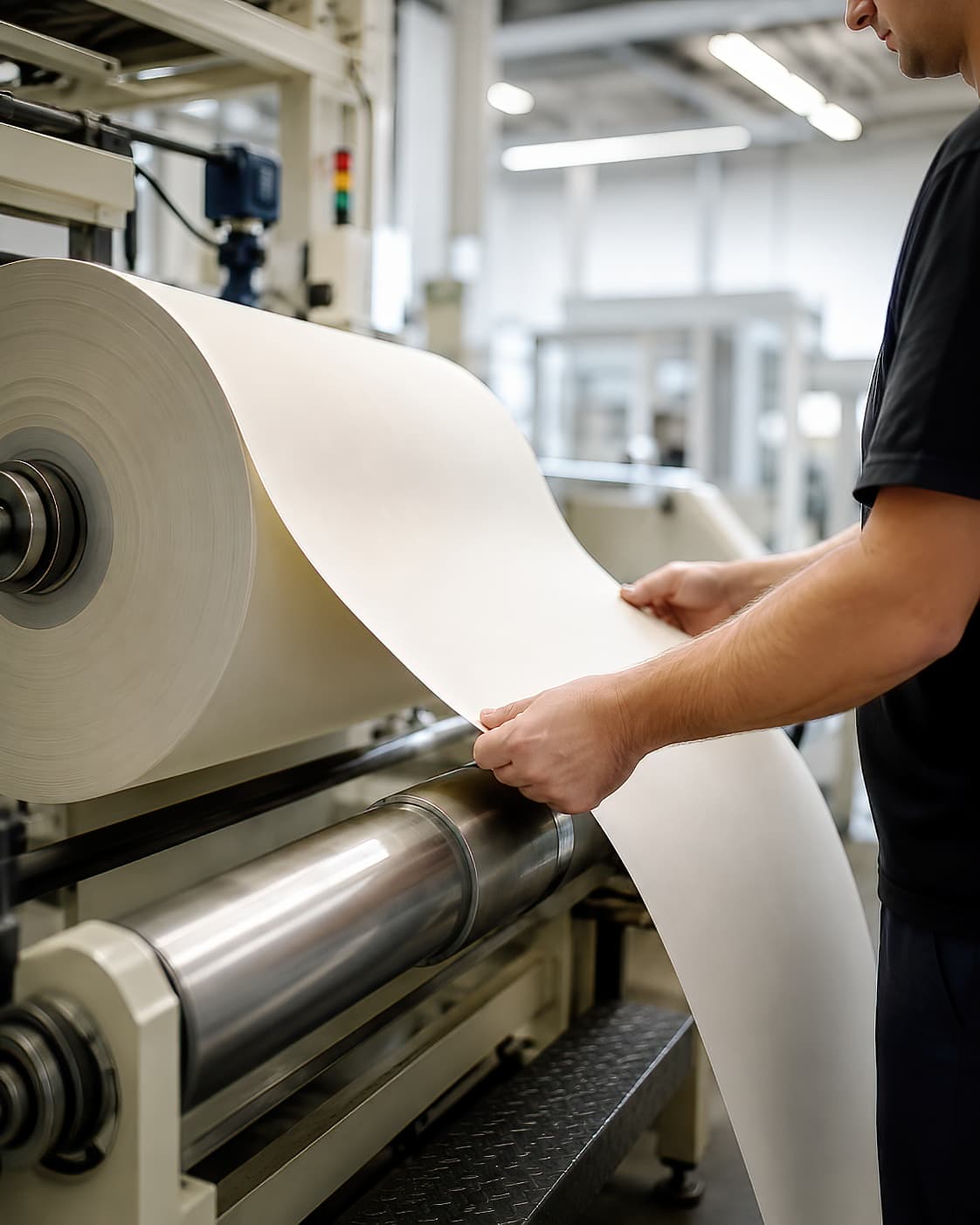
Industrial manufacturing often relies on materials that perform a small but critical role within the production process. Industrial coated papers are a good example.
By combining a suitable paper substrate with a functional coating, these papers can provide controlled release, separation, surface protection and reliable handling across demanding manufacturing environments. They are used in applications including adhesive processing, double-sided tape separation, bitumen and butyl extrusion, hot-melt adhesive packaging and specialist converting.
For manufacturers, selecting the right industrial coated paper is therefore about more than choosing a paper weight or size. The substrate, coating, temperature resistance, release properties and finished format must all work together within the manufacturing process.
What Are Industrial Coated Papers?
Industrial coated papers are paper substrates that have been treated or coated to provide specific functional properties. Unlike papers intended primarily for printing or presentation, industrial coated papers perform a technical role.
Depending on the specification, they may be designed to:
- provide controlled release from adhesives or tacky materials
- separate materials during manufacturing or storage
- protect surfaces
- withstand elevated temperatures
- reduce unwanted adhesion
- improve handling through production equipment
- support specialist converting or packaging processes
Silicone is commonly used where release performance is required, although the exact substrate and coating specification should always be selected according to the intended application.
Why Are Coated Papers Important in Manufacturing?
Manufacturing processes depend on consistency. If a release paper performs differently between production runs, even relatively small variations can lead to unnecessary waste, slower production or problems with the finished product.
An unsuitable coated paper may contribute to:
- inconsistent release
- material sticking
- tearing
- surface damage
- excessive waste
- additional manual handling
- reduced production efficiency
The correct industrial coated paper can help provide predictable performance throughout production. This becomes especially important in high volume manufacturing, where small improvements in material performance can become significant when repeated across thousands of production cycles. The aim should therefore be to specify a paper that supports the wider manufacturing process rather than simply purchasing the lowest cost material available.
Key Properties of Industrial Coated Papers
No single coated paper specification will suit every industrial application. Several properties should be considered.
Controlled Release
Release performance is one of the most important characteristics in many industrial applications. The coated surface must separate from the material it contacts at the correct stage of production.
Release that is too easy may allow materials to move or separate prematurely. Release that is too difficult may result in tearing, deformation or slower processing. The objective is therefore controlled and consistent release.
Manufacturers dealing specifically with this type of material can also read our guide to choosing the right release paper for industrial applications.
Temperature Resistance
Some manufacturing processes expose coated paper to elevated temperatures. The substrate and coating must remain sufficiently stable under the intended production conditions.
Linwood Raker manufactures specialist siliconised release papers for demanding industrial applications, including processes involving temperatures above 150°C. Temperature should not, however, be considered in isolation. Exposure time, pressure, the material being processed and other production conditions should also be assessed.
Strength and Handling
Industrial papers may pass through rollers, cutting equipment, converting machinery and other production systems. The paper must therefore provide sufficient strength while maintaining the flexibility and surface properties required by the application. A material that tears, stretches or behaves inconsistently can disrupt production even if its coating performs correctly.
Surface Consistency
Uniformity across the coated surface is essential where consistent release or separation is required. Variations can affect product positioning, processing speed and finished product quality. For manufacturers, consistency between production batches is often just as important as the performance of an individual sheet or reel.
Types of Industrial Coated Paper
Different paper substrates provide different physical and surface characteristics.
Siliconised Release Paper
Siliconised paper is widely used where controlled release from adhesives, compounds and other tacky materials is required. A silicone coating reduces adhesion and allows the paper to separate cleanly when required. The paper may be coated on one or both sides depending on the application.
More information can be found in our guide to silicone release paper.
Glassine
Glassine is a smooth, dense paper commonly used for release and separation applications. Its refined surface makes it suitable where consistent coating and controlled surface characteristics are important.
Super Calendared Kraft
Super calendared kraft, often referred to as SCK, has been mechanically finished to create a smoother and denser surface than conventional kraft paper. It is frequently used as a substrate in specialist release and industrial applications.
Clay Coated Kraft
Clay coated kraft combines the strength associated with kraft paper with a smoother coated surface. It can be useful where both mechanical performance and controlled surface characteristics are required. The correct substrate should always be selected according to the manufacturing process rather than simply by paper type.
Common Industrial Applications
Industrial coated papers are used across a wide range of manufacturing and converting processes.
Double Sided Tape Separation
Double sided adhesive products require a dependable separator to prevent adhesive surfaces bonding together before use. A suitable release paper protects the adhesive while allowing controlled removal during conversion or final application. Consistency is particularly important when tapes are produced or converted at volume.
Bitumen and Butyl Extrusion
Bitumen and butyl based materials are naturally tacky and can create demanding release requirements. Specialist coated papers can prevent unwanted adhesion during extrusion, handling and storage while allowing clean separation when required. The combination of coating performance, paper strength and temperature resistance is particularly important in these applications.
Hot Melt Adhesive Packaging
Hot melt adhesives place additional demands on release materials because elevated temperatures may be involved. A suitable coated paper can provide both heat resistance and controlled release, helping the adhesive to be handled and packaged more efficiently.
Adhesive Manufacturing
Release papers are widely used within adhesive manufacturing and converting. They may protect pressure sensitive adhesives through coating, cutting, slitting, storage and final use. The complete lifecycle of the product should therefore be considered when the release paper specification is selected.
Industrial Separation and Protection
Not every application involves a conventional adhesive. Coated papers may also be used as separators between products or surfaces during manufacturing, transport or storage. This can help prevent surface damage, contamination or unwanted material transfer.
How to Choose the Right Industrial Coated Paper
Selecting an industrial coated paper should begin with the manufacturing process rather than a standard product specification. Several questions should be considered.
What Material Will Contact the Paper?
Adhesives, bitumen, butyl compounds and hot melt materials all behave differently. The coated surface must therefore be compatible with the material being processed.
What Release Performance Is Needed?
The easiest possible release is not always desirable. In many applications, the paper must remain securely positioned during manufacturing before releasing at a particular point in the process. The release level should therefore be matched to the application.
What Temperatures Are Involved?
Both the maximum temperature and length of exposure should be considered. A brief period at elevated temperature may place different demands on a paper than prolonged exposure during production.
How Will the Paper Be Processed?
Machine speed, tension, cutting, folding, die cutting and other production stages can influence paper behaviour. The chosen substrate should therefore be suitable for the entire manufacturing process.
What Format Is Required?
Coated papers can be supplied in formats that integrate directly into production.
At Linwood Raker, specialist papers can be converted into:
- reels
- sheets
- reams
- die-cut shapes
Supplying the correct format can reduce additional processing and simplify material handling.
Standard or Bespoke Coated Paper?
Standard coated papers are suitable for many established industrial applications. However, manufacturing processes do not always fit standard specifications.
A bespoke solution may be more appropriate where:
- release performance is inconsistent
- unusual temperatures are involved
- non-standard dimensions are required
- an unusual adhesive or compound is being processed
- material waste needs to be reduced
- additional converting is currently carried out in-house
Rather than adapting a manufacturing process around an unsuitable material, the coated paper can often be specified around the application. Factors such as substrate, coating, release behaviour, dimensions and converted format can then be considered together.
Linwood Raker’s wider range of specialist coated paper products includes solutions for both established and bespoke industrial requirements.
The Importance of Paper Conversion
The effectiveness of an industrial coated paper is influenced not only by its coating but also by the way it is converted. Supplying paper in the correct dimensions can remove unnecessary manufacturing stages. For example, a customer requiring precision die cut components may gain little benefit from purchasing a large reel and carrying out the conversion separately.
Material supplied closer to its final required format can help reduce:
- secondary processing
- material handling
- cutting waste
- labour
- production setup
- stock complexity
For high volume manufacturers, these efficiencies can become commercially significant.
Reducing Manufacturing Waste
The lowest priced coated paper is not necessarily the lowest cost option once its effect on production is considered. A poorly matched product may create additional costs through waste, machine stoppages, inconsistent release or rejected finished products.
Manufacturers should therefore consider the overall effect of the paper on:
- production efficiency
- material consumption
- labour
- secondary converting
- waste
- finished product quality
A correctly specified industrial paper should provide reliable performance while supporting efficient production.
Industrial Coated Papers and Sustainability
Environmental performance is increasingly important within industrial procurement. The UK paper industry continues to develop its manufacturing knowledge, skills and sustainability practices, supported by organisations such as the Confederation of Paper Industries. Material use can often be reduced through better dimensions, improved conversion and more accurate paper specification.
Paper based solutions may also offer opportunities to replace certain alternative materials where the technical requirements allow. The complete finished construction should always be considered when assessing recycling or environmental performance, particularly where coatings, adhesives or additional materials are involved.
Why Work with Linwood Raker?
Linwood Raker manufactures and converts specialist coated papers for industrial and food contact applications in the UK. Large mill reels can be converted into reels, sheets, reams and precision die cut formats to suit customer requirements. Industrial capabilities include specialist siliconised release papers together with papers such as glassine, clay coated kraft and super calendared kraft.
Applications include:
- adhesive manufacturing
- double sided tape separation
- bitumen and butyl extrusion
- hot melt adhesive packaging
- industrial separation
- bespoke manufacturing processes
Where a standard product does not provide the required performance, a specification can be developed around the intended application. This allows the substrate, coating, release characteristics and finished format to be considered as part of one complete solution.
Frequently Asked Questions
What is industrial coated paper?
Industrial coated paper is a paper substrate that has been given a functional coating to provide properties such as controlled release, separation, protection or heat resistance.
What is industrial coated paper used for?
Applications include adhesive processing, tape separation, bitumen and butyl extrusion, hot melt adhesive packaging and specialist industrial separation.
What is the difference between coated paper and release paper?
Coated paper is a broad term covering paper with a functional surface treatment. Release paper is a specific type of coated paper designed to separate cleanly from adhesives or other materials.
Can industrial coated paper withstand high temperatures?
Certain specifications are designed for elevated temperature applications. The correct product should be selected according to the temperature, exposure time and wider manufacturing conditions.
Can industrial coated papers be made to bespoke sizes?
Yes. Papers can be converted into reels, sheets, reams and die cut formats to suit individual manufacturing processes.
Find the Right Industrial Coated Paper for Your Process
Industrial coated paper can influence manufacturing efficiency, waste levels, product quality and production consistency. The correct solution starts with an understanding of the application. Substrate, coating, release performance, temperature resistance, dimensions and converted format can then be considered together.
If you are reviewing an existing industrial paper, developing a new product or experiencing inconsistent release performance, Linwood Raker can help identify a suitable coated paper solution.